
# Stop hoarding digital debris. Explore the Best AI Note-Taking Apps 2026 in this deep dive. From Recall’s knowledge graphs to Notion’s autonomous agents, discover how the new cognitive workflow transforms you from a librarian into a digital architect.
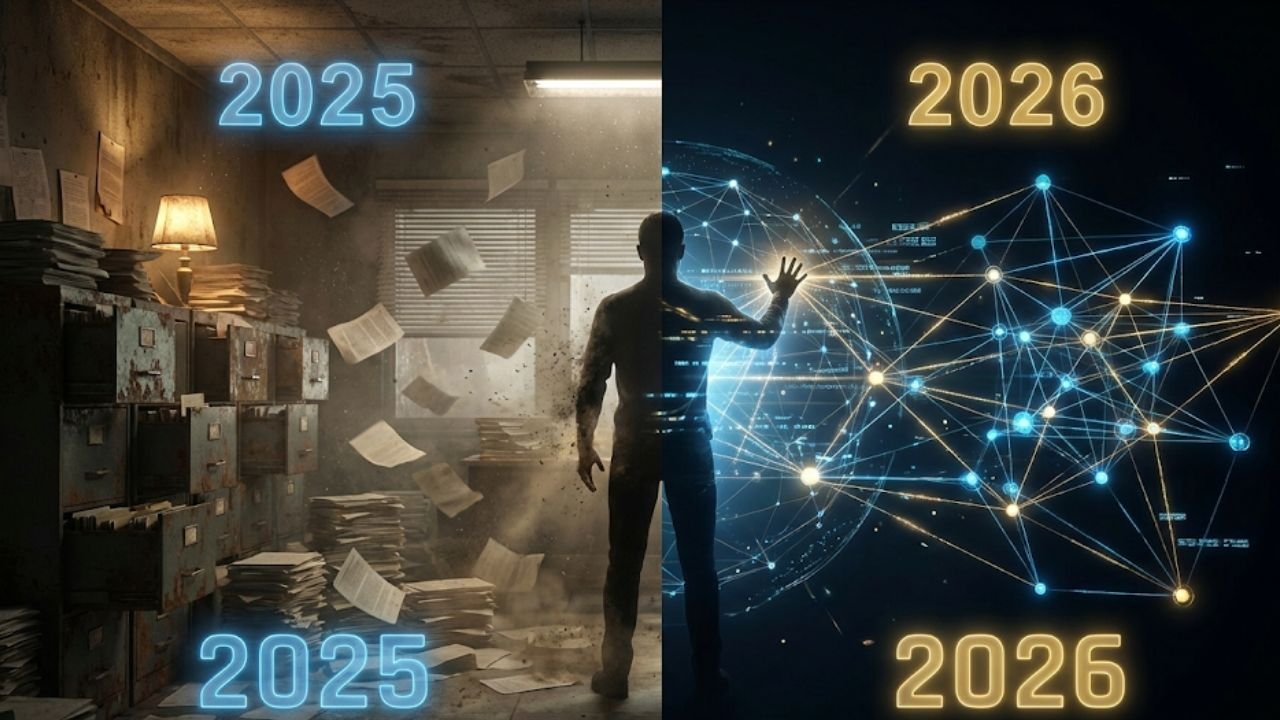
AnimaVersa – The digital productivity landscape has undergone a seismic shift as we settle into 2026, moving away from the chaotic accumulation of digital debris toward a more refined, elegant era of cognitive assistance. For years, the prevailing dogma of “productivity” was centered around the concept of the Second Brain—a term that eventually morphed into a burdensome mandate to hoard every article, video, and snippet of text we encountered. We were promised that if we just saved enough bookmarks and organized enough folders, we would eventually achieve a state of enlightenment.
Instead, we collectively burned out, buried under the weight of “read-it-later” lists that became “read-never” graveyards. The fatigue of maintaining complex systems for the sake of the system itself has finally broken, and in its place, a new philosophy of software design has emerged. The tools of 2026 are no longer trying to be generic digital dumpsters; they are hyper-specialized engines designed to solve specific, painful workflow problems with surgical precision. We are witnessing the death of the generic “note-taking app” and the rise of the specialized “thought partner.”
This evolution is driven by a fundamental realization that our brains do not function like file cabinets, and therefore our software shouldn’t either. The human mind works through association, connection, and context—it remembers a fact because of where you were when you heard it, or who said it, or how it relates to a book you read three years ago.
The new vanguard of AI applications—Recall, Reflect, Notion, Anara, and Jamie—have abandoned the folder metaphor in favor of knowledge graphs, contextual awareness, and active resurfacing. They are not designed to hold your information; they are designed to interact with it. They operate on the premise that information is useless unless it is surfaced exactly when you need it, often before you even realize you need it. This distinction is critical because it shifts the user’s role from a digital librarian, endlessly tagging and filing, to a digital architect who simply directs the flow of information while the AI handles the heavy lifting of organization and retrieval.
Recall: The Architecture of the Extended Mind
Leading this charge against the friction of information recall is an application appropriately named Recall. It addresses perhaps the most pervasive anxiety of the modern knowledge worker: the fear of forgetting valuable information consumed across the fractured landscape of the internet. In the past, saving a YouTube video meant adding it to a “Watch Later” playlist where it would languish for eternity. Saving a podcast meant remembering a timestamp.
Saving an article meant tossing it into a black hole like Pocket or Instapaper. Recall reimagines this process by positioning itself not as a storage bin, but as a personal knowledge engine—essentially a private, secure version of ChatGPT that is trained exclusively on the content you have explicitly chosen to save. This distinction is paramount. Unlike a generic LLM that hallucinates facts from the open web, Recall operates within the walled garden of your own curated consumption. It digests YouTube videos, Spotify podcasts, PDFs, and articles, summarizing them and—crucially—weaving them into a searchable knowledge graph.
The genius of Recall lies in its rejection of manual organization. The friction of tagging is removed entirely. When you save a piece of content, the system automatically analyzes it, identifies key entities—like “Max Verstappen” or “The Roman Empire”—and links them to every other piece of content in your library that mentions those terms. This creates a web of associations that grows stronger with every addition, mirroring the neural pathways of the brain.
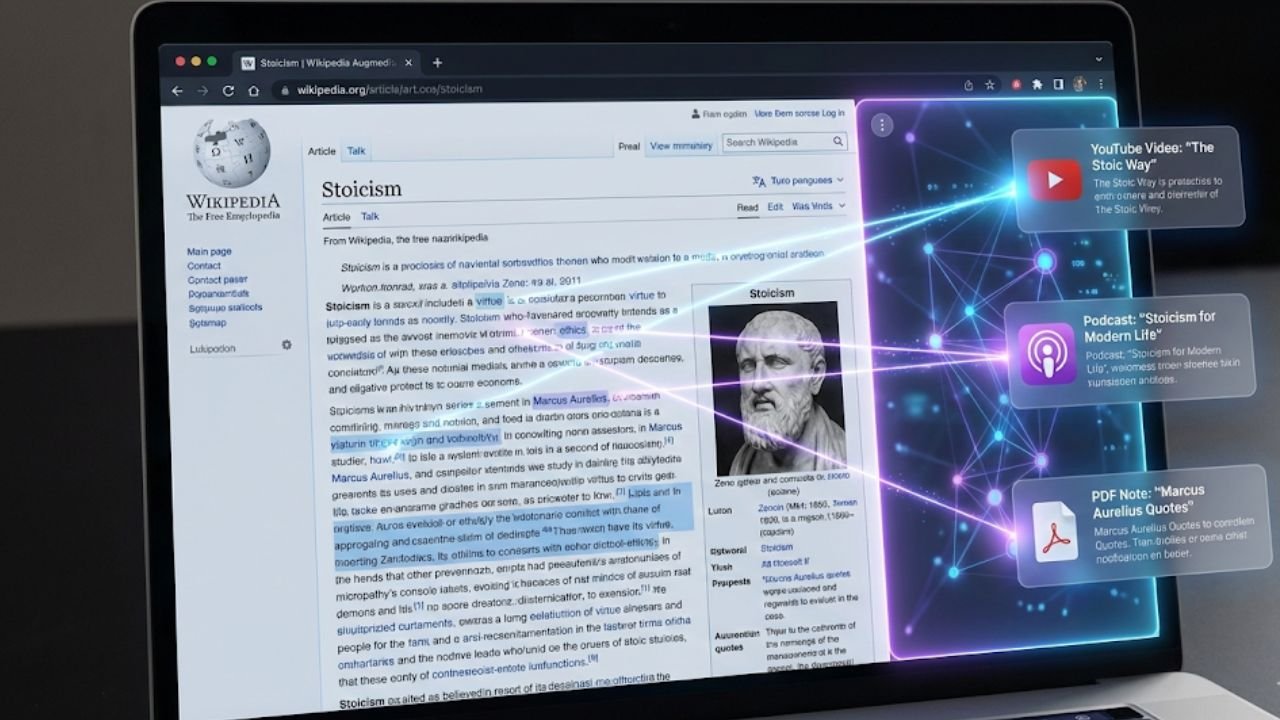
The “Graph View” offers a visual representation of these connections, allowing users to physically see how their interests intersect and diverge. But the true killer feature, the one that fundamentally changes how we browse the web, is “Augmented Browsing.”
As you navigate the internet, Recall works silently in the background. If you land on a Wikipedia page about stoicism, and you previously saved a podcast about Marcus Aurelius three months ago, Recall will highlight the relevant concepts on the page and surface your past knowledge in a sidebar. This eliminates the silo between “learning” and “browsing,” turning the entire web into a canvas that interacts with your personal library. It solves the problem of information dormancy by ensuring that nothing you save is ever truly lost, only waiting for the right context to reappear.
Beyond mere retrieval, Recall actively combats the degradation of memory through scientifically backed methods. It incorporates a “Recall Cards” and quiz system that utilizes spaced repetition, a learning technique usually reserved for medical students using apps like Anki. By automatically generating quizzes from saved podcasts, lectures, or PDFs, Recall forces the user to actively engage with the material rather than passively consuming it.
This feature transforms the app from a passive archive into an active tutor. The pricing model reflects its utility as a serious tool for knowledge workers, offering a free tier with limitations on summaries, but scaling to a paid model that unlocks unlimited summaries and the full power of the knowledge graph.
User reviews highlight that while the monetization model can be a barrier for some, specifically students, the utility of having a “private Google” for one’s own intellectual history is often seen as worth the investment. The application’s ability to act as a “Global Chat” for your entire digital existence means you can ask complex questions like “What are the common themes between the podcasts I listened to last week and the PDF I just read?” and receive a synthesized answer that bridges formats and sources.
Reflect: The Fortress of Solitude for Networked Thought
While Recall masters the art of consumption and retrieval, the application Reflect approaches the productivity puzzle from the perspective of the synthesizer and the thinker. If Recall is for the inputs, Reflect is for the outputs. It positions itself as a tool for Personal Knowledge Management (PKM) that prioritizes the speed of thought and the security of the user’s mind. Reflect acknowledges that the act of writing is often where thinking happens, and it facilitates this by mimicking the brain’s associative nature through “backlinks.”
When a user types a concept in double brackets, they are not just creating a hyperlink; they are creating a bi-directional neural pathway between ideas. This allows a user to traverse their own thoughts non-linearly, jumping from a meeting note to a book summary to a daily journal entry with the fluidity of a wandering mind. This networked approach to note-taking prevents ideas from becoming orphaned in static documents, a common failing of traditional hierarchical file systems.
Reflect’s commitment to the “thinker” persona is further evidenced by its robust integration with the tools of the intellectual trade, specifically the Amazon Kindle. For many, the highlights taken while reading a book are the raw materials of future insights, yet they often remain trapped within the Amazon ecosystem. Reflect automates the liberation of these highlights, syncing them directly into the user’s daily notes and indexing them for future retrieval.
This means that a quote highlighted at midnight can be instantly referenced in a meeting the next morning. Furthermore, Reflect differentiates itself through a staunch commitment to privacy, offering end-to-end encryption by default. In an era where AI companies are voraciously scraping user data to train their models, Reflect offers a sanctuary where thoughts remain private, accessible only to the user. The inclusion of an offline mode further reinforces this reliability, ensuring that the external brain functions even when the internet connection is severed. It is a tool designed not just for storage, but for the cultivation of wisdom through the secure, long-term compounding of ideas.
The user experience of Reflect is often compared to Notion, but with a critical distinction in philosophy. Where Notion is a “jack of all trades,” often succumbing to feature bloat and lag as workspaces grow, Reflect is described as “snappy,” “responsive,” and focused. It avoids the temptation of becoming a project management tool or a database engine, staying true to its core mission of text-based thought.
The daily note is the anchor of the Reflect workflow, providing a friction-free starting point for every day. Unlike Notion, which requires the user to architect a system before they can begin working, Reflect greets the user with a blank page dated for today, inviting immediate brain dumping. The “Assistant” feature, accessed via Command G, uses GPT-4 to act as a writing coach, fixing grammar, rephrasing text, or generating outlines, but it does so without hijacking the user’s voice. This subtle integration of AI supports the writing process rather than replacing it, adhering to the principle that technology should augment human cognition, not automate it away.
Notion: The Operating System of the Intelligent Enterprise

However, for individuals and teams who require their AI to be more than a librarian or a mirror—who need it to be an active participant in project management and database creation—Notion remains the titan of the industry. The narrative around Notion in 2026 has shifted from it being a “Lego set” for productivity nerds to a sophisticated, AI-integrated workspace.
The introduction of Notion AI has transformed the platform from a passive repository into an active agent. Unlike standalone chatbots that require context to be copy-pasted into a prompt, Notion AI lives inside the context. It “sees” the databases, the project specs, the meeting notes, and the wikis. This allows for a feature explicitly devised to kill the “search” bar: Q&A. Instead of searching for “Q3 marketing report,” a user can simply ask, “What did we decide about the Q3 budget in last week’s meeting?” and Notion AI will scan the relevant pages, synthesize the answer, and provide citations to the source documents.
This capability extends into the structural DNA of Notion through database automation. The friction of data entry—filling out rows, tagging status, summarizing feedback—is eroded by AI properties that autofill based on the content of the page. If a user dumps a raw transcript of a user interview into a database, Notion AI can automatically extract the sentiment, identify feature requests, and generate a summary in the adjacent columns.
This transforms Notion from a tool that requires maintenance into a system that maintains itself. The “Agent” functionality introduced in late 2025 further amplifies this, allowing the AI to perform multi-step workflows across connected apps like Slack and Google Drive. It is no longer just about taking notes; it is about creating a self-organizing operating system for work where the AI acts as the connective tissue between disparate pieces of information. For teams, this means the end of the “information silo” and the beginning of the truly intelligent workspace where the answer to any question is always just a prompt away.
The evolution of Notion into “Notion 3.0” with Agents marks a distinct departure from its predecessors. It is now capable of “Research Mode,” a feature that allows it to scour the open web alongside internal documents to create comprehensive reports. This blurs the line between internal knowledge management and external market research. A product manager can ask Notion to “Analyze our Q3 sales data and cross-reference it with customer feedback in Slack to identify the top three complaints,” and the Agent will execute this complex, multi-modal task.
This power comes with a trade-off, however. The complexity of Notion can be overwhelming for those who simply want to write. The “all-in-one” promise means it does everything reasonably well, but perhaps nothing as perfectly as a specialized tool. Yet, for the enterprise user, the value of having documentation, project management, and AI intelligence in a single, unified interface is a compelling argument against the fragmentation of the app ecosystem.
Anara: The Academic Weapon Against Hallucination
While Notion conquers the enterprise and project management space, a specific and often overlooked demographic faces a unique set of challenges: the student and the academic researcher. The brutality of being a student in 2026 cannot be overstated. The volume of reading required is immense, the complexity of the language is exclusionary, and the penalty for inaccuracy is severe.
Enter Anara (formerly known as Unriddle), a tool designed specifically to weaponize the academic workflow against the overwhelm of research. Anara distinguishes itself by rejecting the “generative” focus of other tools in favor of “analytical” precision. When a researcher uploads a 100-page PDF of a dense academic paper, Anara doesn’t just summarize it; it dissects it. The AI reads the entire document—methodology, results, discussion—and becomes an expert on that specific text.
The “killer feature” that makes Anara indispensable for serious academic work is its solution to the “hallucination” problem that plagues generalist LLMs like ChatGPT. When Anara answers a question about a paper, it doesn’t just generate text; it provides clickable citations that link directly to the exact sentence in the source PDF where the information originates. This accountability is non-negotiable in academia. A student can verify every claim instantly, ensuring that their literature review is grounded in fact rather than AI fabrication.
Furthermore, Anara understands the interconnected nature of research. It allows users to upload groups of papers and ask questions across the entire corpus, synthesizing findings, identifying contradictions, and spotting research gaps. It can even turn lecture slides and recordings into flashcards and quizzes, automating the “active recall” study method. By focusing narrowly on the needs of the researcher—accuracy, citation, and synthesis—Anara carves out a niche that broad tools cannot touch, becoming a lifeline for those drowning in academic literature.
Anara’s capabilities extend to the writing process as well, offering an environment that supports the specific formatting needs of academic publishing. It integrates with citation managers like Zotero and Mendeley, streamlining the often-tedious bibliography creation process. The platform’s ability to handle multi-paper synthesis allows researchers to compare methodologies across dozens of studies in seconds, a task that would manually take weeks.
This “Deep Search” agent capability, introduced in late 2025, runs multiple passes through content to aggregate and analyze data at a granular level, producing responses that are rich in detail and rigor. For the PhD candidate or the professional researcher, Anara is not just a productivity tool; it is a verification engine that safeguards the integrity of their work while exponentially increasing the speed at which they can process information.
Jamie: The Silent Guardian of the Meeting Room
Finally, we arrive at the most universally despised aspect of modern professional life: the meeting. The sheer volume of hours lost to Zoom, Teams, and Meet is staggering, and the cognitive load of participating in a conversation while simultaneously trying to transcribe it is a recipe for poor performance in both tasks. Jamie (or JAI) enters this space not as another “bot” that awkwardly joins the call, announces its presence, and makes everyone uncomfortable, but as a silent, invisible executive assistant.
The differentiation here is subtle but profound. Most meeting AI tools act as “participants,” showing up in the user list and recording the video, which can feel intrusive and raise privacy concerns (“sus,” as the younger generation might say). Jamie operates at the system audio level, living on the user’s desktop rather than in the cloud conference room. It listens to the audio output of the computer, transcribing and summarizing without ever “joining” the meeting.
This “no-bot” approach preserves the sanctity and natural flow of human conversation. Participants speak freely, unburdened by the flashing red light of a recording bot, while Jamie works in the background to capture every decision, action item, and nuance. The output is not just a wall of text, but a structured “executive summary” that separates casual chatter from critical business intelligence.
Jamie effectively solves the dilemma of “listen or write” by allowing the user to be fully present in the conversation, secure in the knowledge that the documentation is being handled with superhuman accuracy. It even supports offline recording for in-person meetings, a feature that cloud-based bots simply cannot offer. By respecting privacy and prioritizing the user experience, Jamie transforms the meeting from a productivity sinkhole into a structured data asset, ensuring that no good idea is ever lost to the ether of a forgotten conference call.
Pricing and privacy are central to Jamie’s value proposition. Unlike competitors that lock critical features behind expensive enterprise tiers, Jamie offers a flexible model that includes a free tier for casual users and Pro plans for power users who need unlimited meeting minutes. The focus on GDPR compliance and local data handling appeals to European markets and privacy-conscious industries like legal and finance, where uploading sensitive client calls to a third-party cloud is a non-starter.
User reviews frequently cite the “bot-free” nature as the primary reason for switching from tools like Otter.ai, highlighting a growing market demand for AI that is helpful without being intrusive. Jamie represents the future of ambient computing—tools that exist in the periphery, observing and assisting without demanding our attention or altering our social dynamics.
The Great Convergence: Choosing Your Cognitive Stack
The overarching theme of 2026’s tool landscape is the rejection of the “all-in-one” fallacy in favor of the “best-in-class” specialist. The user does not need to choose between these apps; they need to choose the app that solves their specific bottleneck. If the problem is information hoarding and retrieval, Recall provides the neural network to manage it. If the problem is synthesizing complex thoughts and writing, Reflect offers the encrypted canvas. If the problem is team coordination and project data, Notion AI provides the automated infrastructure. If the problem is surviving a PhD program, Anara offers the rigorous analytical support. And if the problem is the endless barrage of meetings, Jamie provides the silent, automated minutes.
We are witnessing a divergence in the market. On one side, we have the behemoths like Notion, attempting to be the operating system for everything, integrating agents and automation to keep users within their walled gardens. On the other side, we have the nimble specialists like Recall and Jamie, which focus on doing one thing exceptionally well and integrating with the rest of the user’s life. This fragmentation is not a weakness but a strength. It allows users to construct a “stack” that mirrors their own cognitive style.
A creative director might pair Recall for inspiration gathering with Reflect for journaling, while a product manager might rely heavily on Notion for execution and Jamie for meeting documentation. The “Second Brain” concept has not died; it has matured. It has evolved from a manual labor camp where we worked for our software into an automated ecosystem where our software works for us. We are no longer digital janitors, sweeping up data into piles. We are conductors, orchestrating a symphony of specialized agents that allow us to think faster, remember more, and work with a level of clarity that was previously impossible.
Pricing and Accessibility: The Barriers to Entry
However, this brave new world of cognitive augmentation comes with a price tag. The transition from free, ad-supported tools to subscription-based AI models is complete. Recall, Reflect, and Jamie all operate on subscription models that, while offering free tiers, reserve their most potent features for paying customers. Reflect’s flat $10/month fee is a refreshing simplicity in a market of complex tiers, but it still represents a recurring cost for access to one’s own thoughts.
Jamie’s pricing can scale up to nearly €99/month for executive-level features, positioning it clearly as a business tool rather than a consumer toy. Anara’s Pro plan is essential for any serious researcher dealing with large volumes of text. This economic reality creates a divide between those who can afford to augment their intelligence with these tools and those who cannot. As these tools become more essential for professional competitiveness, this digital divide will likely widen, raising questions about equity in the age of AI.
Yet, for the professional, the ROI is often undeniable. The time saved by not having to manually tag thousands of notes in Recall, or the ability to instantly surface a citation in Anara, or the freedom to focus in a meeting while Jamie takes notes, translates directly into productivity and reduced burnout. The “cost” is not just the monthly subscription, but the cognitive load that is offloaded to the machine. In 2026, the most valuable currency is attention, and these tools are essentially selling it back to us. They purchase our mental clarity for a monthly fee.
The Future of Work: Agentic Workflows
Looking forward, the trend is clear: Agentic Workflows. We are moving beyond “chatting” with our notes to having our notes take action. Notion’s introduction of Agents that can proactively update databases and draft emails is just the beginning. We can expect Recall to eventually not just surface old content, but to proactively suggest new content based on our gaps in knowledge. We might see Jamie not just summarizing meetings, but automatically scheduling follow-ups and populating task managers in Reflect or Notion. The interoperability between these tools will be the next battleground.
Currently, they exist largely as islands, connected only by the user’s copy-paste function or rudimentary integrations. The “Super App” that seamlessly connects the knowledge graph of Recall with the writing environment of Reflect and the database power of Notion is the holy grail that has yet to be built. Until then, the savvy user must act as the bridge, selecting the right tool for the right mode of thought.
The brutality of the modern information environment demands nothing less than these sophisticated prosthetics. To survive and thrive in 2026, one must embrace these tools not as novelties, but as essential extensions of the mind. The era of the passive note-taking app is over. The era of the active, intelligent thought partner has arrived. Whether you are a student fighting through a dissertation, a manager drowning in Zoom calls, or a creative trying to connect the dots between disparate ideas, there is now a machine designed to think with you. The only question remaining is: are you ready to let it?
Summary of Key Insights
- Recall: Solves information hoarding by creating an automated Knowledge Graph and Augmented Browsing experience, linking saved content (YouTube, Spotify, PDFs) directly to your web surfing.
- Reflect: Targets the “Thinker” with a focus on Backlinks, End-to-End Encryption, and Kindle Sync, ensuring a private and secure environment for journaling and idea synthesis.
- Notion AI: Dominated by Context-Awareness; it moves beyond simple chat to become an Agent that can answer questions about your specific workspace data and automate database properties.
- Anara (formerly Unriddle): The “Academic Weapon” that prioritizes Accuracy over generation, providing clickable citations that link back to the source text to prevent AI hallucinations in research.
- Jamie: The “Anti-Bot” meeting assistant that runs locally on the desktop (System Audio) rather than joining calls, preserving privacy and eliminating the awkwardness of recording bots.
- Philosophy Shift: The trend has moved from “All-in-One” apps to Problem-Specific tools; the goal is to reduce the friction of manual tagging and organizing.
Read the full review on Raven S for a deeper breakdown of pricing and hidden features. Follow and like AnimaVersa on social media to stay ahead of the AI productivity curve!

Raven S., is a technologist, professional coder, and software enthusiast with a singular vision: to bring transparency, depth, and genuine expertise to tech journalism.