
# Deciding between Ghost vs Substack in 2026? We break down the math, the ‘Substack Tax,’ and why Ghost 6.0’s ActivityPub integration makes it the superior choice for developers and tech bloggers who value ownership
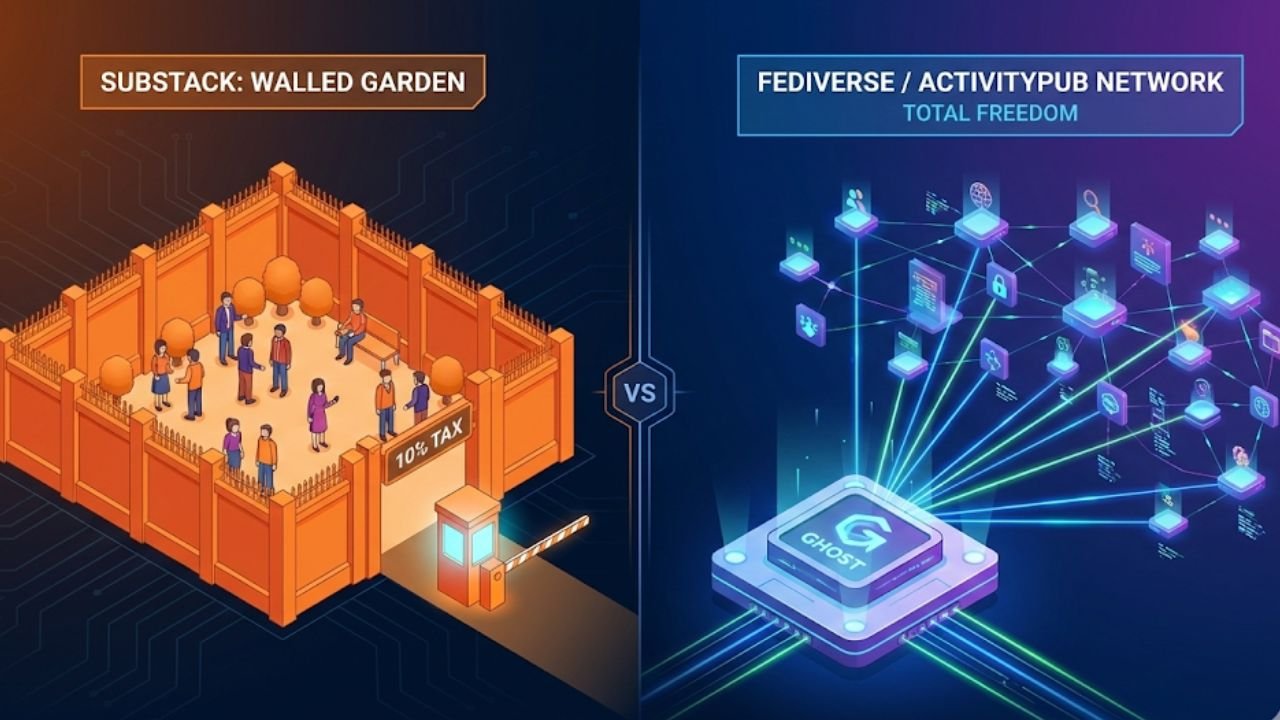
AnimaVersa – The debate between Ghost and Substack has evolved. In 2024, it was a simple question of “Ease vs. Control.” Now, in 2026, as the “Dead Internet” theory feels increasingly like reality and AI search engines like Perplexity reshape how we discover information, the debate has shifted to a much more critical axis: Algorithm vs. Ownership.
For the non-technical writer, the poet, or the casual diarist, Substack remains a seductive proposition. It is a pre-furnished room in a bustling hotel, offering warmth, community, and zero maintenance. But for the developer, the tech strategist, or the serious independent publisher, Substack has revealed itself to be something else entirely—a social network that demands a punitive tax on your gross revenue in exchange for a “discovery” algorithm that you cannot control, cannot predict, and cannot own.
Conversely, Ghost has matured into what can best be described as a “Federated Operating System” for independent publishing. With the landmark release of Ghost 6.0 in August 2025, which fully integrated ActivityPub, Ghost ceased to be just a Content Management System (CMS). It became a node in the open web, allowing your publication to speak directly to the Fediverse without intermediaries.
This report dissects the technical, financial, and strategic differences between these two platforms. It is not written for the hobbyist sharing shower thoughts; it is written for the builder who intends to own their audience, their revenue, and their code. We will look at the hard math of the business models, the technical reality of SEO in an AI-driven world, and the developer experience of managing a publication as a software product.
The Economics (The “Tax” vs. The “Rent”)
The financial divergence between Ghost and Substack is not merely a difference in pricing tiers; it is a fundamental difference in business philosophy. Substack operates on a Revenue Share Model, functioning essentially as a tax on your success. Ghost operates on a SaaS (Software as a Service) Model, functioning as a fixed operating cost, or “rent.”
The Substack Tax: 10% Forever
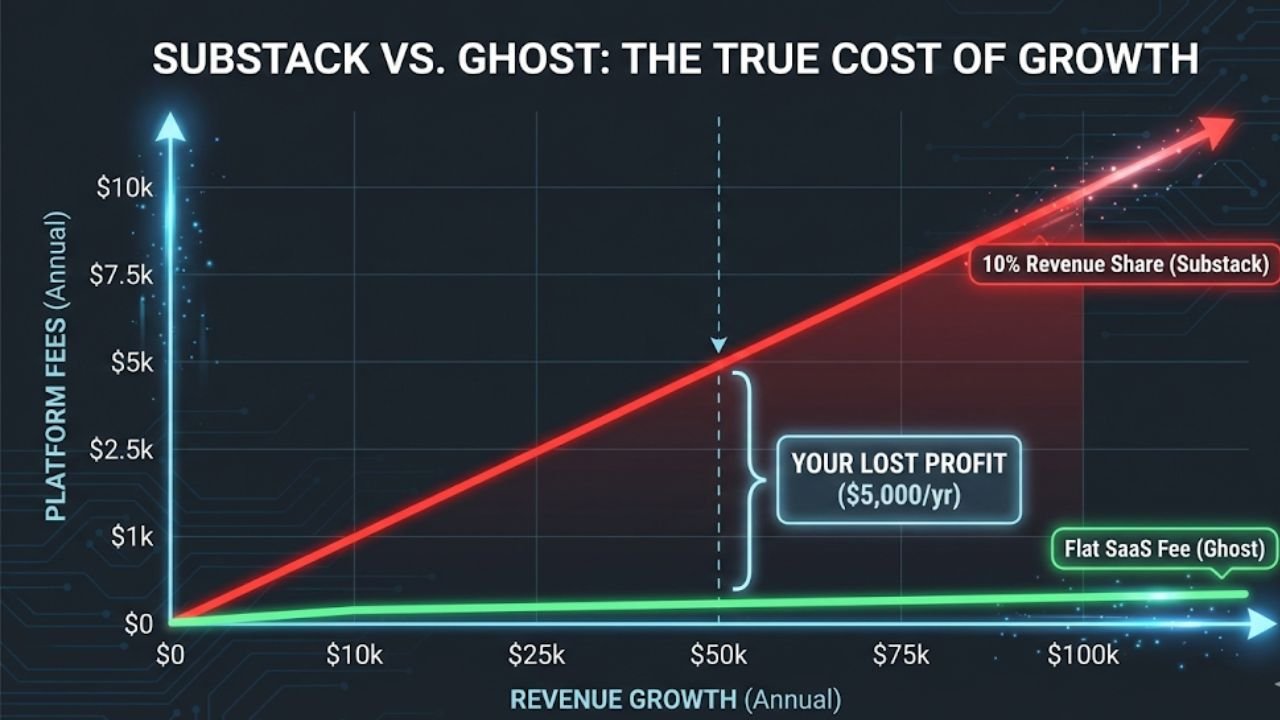
Substack’s value proposition is “free to start.” There are no monthly hosting fees, no credit card required to sign up. However, the platform claims 10% of every dollar you generate from paid subscriptions. This is in addition to the standard Stripe processing fees (roughly 2.9% + $0.30 per transaction).
While 10% sounds negligible when you are earning $100/month (a $10 fee), it becomes punitive at scale. The model is regressive: the more successful you become, the more you are penalized. If a technical blog achieves $50,000 in annual revenue—a modest target for a successful niche newsletter or a developer selling a premium course—Substack extracts $5,000 annually. That is the cost of a high-end development workstation, a dedicated part-time editor, or a substantial marketing budget, effectively vanished into the platform’s coffers. As Substack’s own support documentation confirms, this 10% cut is mandatory and permanent for all paid subscriptions.
The Ghost Flat Fee: Cheaper for Success
Ghost generates revenue through Ghost(Pro), its managed hosting service. As of the pricing updates in July 2025, the structure is designed to be a flat operational expense. The “Starter” plan begins at roughly $15 per month (billed annually), and the “Publisher” plan, which unlocks custom themes and analytics—essential for any serious developer—starts at $29 per month.
Crucially, Ghost takes 0% of your subscription revenue. The only deduction is the unavoidable Stripe processing fee, which goes directly to the payment processor, not Ghost. This distinction is critical. Ghost acts as a utility provider: you pay them to keep the lights on and the servers running. They do not demand a share of your profits.
Financial Modeling: A 5-Year Projection
Let us model a trajectory for a tech blogger growing from 0 to 2,000 paid subscribers over a 5-year period. This model assumes a standard subscription price of $10/month.
Scenario A: The “Ramping Up” Phase (Year 3)
By Year 3, let’s assume you have reached 500 paid subscribers. This generates $5,000/month in gross revenue ($60,000/year).
- Substack Costs:
- You pay 10% of $60,000.
- Total Fee: $6,000/year.
- Ghost Costs (Business/Publisher Plan):
- To support 500 members and utilizing necessary features, you might be on a plan costing roughly $35-$50/month (or less if optimizing annual billing). Let’s conservatively estimate a $600/year hosting cost.
- Total Fee: ~$600/year.
- The Difference: In this mid-growth phase, you are already losing $5,400 per year by choosing Substack. That is a significant amount of capital that could be reinvested into content creation or advertising.
Scenario B: The “Scaling” Phase (Year 5)
By Year 5, you have hit 2,000 paid subscribers. This generates $20,000/month in gross revenue ($240,000/year).
- Substack Costs:
- You pay 10% of $240,000.
- Total Fee: $24,000/year.
- Note: This is a staggering sum. You are essentially paying the salary of a junior employee just for the privilege of using a blogging platform.
- Ghost Costs:
- Even on a higher tier “Business” plan to support the volume and staff users, your costs might hover around $2,400/year ($199/mo).
- Total Fee: ~$2,400/year.
- The Difference: You save $21,600 per year with Ghost. Over a decade, this difference compounds into hundreds of thousands of dollars in lost value.
The “Hidden Costs” of Free
Substack defenders often argue that the 10% fee covers “hosting, email delivery, and support.” However, when you do the math, the markup is exorbitant. Sending emails via Mailgun (which Ghost uses) or Amazon SES is incredibly cheap. Substack is charging premium enterprise rates for commodity infrastructure.
Verdict: The “Tax” punishes growth. Ghost is mathematically superior for any publication generating over roughly $300/month. If you intend to succeed, Substack is effectively the most expensive hosting provider on earth.
SEO & Discovery (The AI Era)
In 2026, “Discovery” has bifurcated. There is Algorithmic Discovery (social feeds, recommendations) and Search Discovery (Google, Perplexity, ChatGPT). The way these two platforms handle this split is radically different.
Substack: The Walled Garden
Substack has pivoted aggressively toward becoming a closed social network. Its “Notes” feature creates an internal loop of engagement, similar to X (formerly Twitter). While this can provide an initial boost for new writers via the “Recommendation Network,” it comes at a massive cost to your long-term SEO and digital footprint.
Technical SEO on Substack is severely limited. As a developer, you will find the lack of control frustrating:
- No Sitemap Control: You cannot customize your
sitemap.xmlor control priority. You enter the black box, and you hope Google parses it correctly. - No Robots.txt Access: You cannot exclude specific low-value pages from indexing to preserve your crawl budget.
- Canonical Tag Issues: Advanced users have reported difficulties in managing canonical tags for syndicated content. If you cross-post to Medium or dev.to, you risk duplicate content penalties because Substack assumes it is the primary source.
- URL Structure Rigidity: You are locked into the
substack.comarchitecture unless you pay a one-time fee for a custom domain, but even then, the underlying permalink structure remains rigid and unchangeable.
Furthermore, Substack’s content is often walled off. AI search engines like Perplexity often struggle to parse content hidden behind Substack’s aggressive “Sign in to read” overlays. If the AI cannot read your content, it cannot cite you as an authority.
Ghost: Technical SEO & The Federation
Ghost is built on Node.js and is fundamentally a headless CMS designed for the open web. It excels in Technical SEO out of the box, speaking the language of search engines fluently.
- Schema Markup: Ghost automatically generates structured data (JSON-LD) for articles. This ensures that when your review of a new JavaScript framework appears in search results, it has the rich snippets that drive click-through rates.
- Speed: Ghost themes are typically lightweight and fast. The default themes like “Source” consistently score 95+ on Google PageSpeed Insights, which remains a critical ranking factor in 2026.
- Custom Metadata: You have granular control over meta titles, descriptions, and Open Graph tags for every single post. You can dictate exactly how your link appears on X, LinkedIn, or in a Slack channel.
The ActivityPub Revolution (Ghost 6.0)
The most significant shift in the 2026 landscape is Ghost’s full integration with the Fediverse. With the release of Ghost 6.0 in August 2025, Ghost sites now natively support ActivityPub.
This is a game-changer for ownership.
- The Mechanism: Your domain
@index@yourdomain.comcan be followed by users on Mastodon, Threads, or Bluesky (via bridges). - The Impact: When you publish a post, it is not just emailed; it is broadcast natively into the feeds of millions of Fediverse users. Unlike Substack’s “Notes,” which keeps users trapped inside the Substack app, Ghost’s federation brings users out of social networks and onto your owned domain.
- Network Effects: You are building a social graph that you own. If you move your Ghost site to a different server, your followers move with you. On Substack, your “followers” on Notes are locked to the platform; you cannot export them.
Developer Experience (Customization)
For the tech blogger, the ability to display code, customize workflows, and integrate tools is non-negotiable. This is where the gap between the two platforms widens into a canyon.
Substack: The “No-Code” Straitjacket
Substack is hostile to developer needs. It is designed for text, not for code.
- No API: As of 2026, Substack still refuses to offer a public API. This means you cannot programmatically fetch your subscribers, automate content publishing, or sync your data with a CRM. You are stuck with manual CSV exports.
- Code Blocks: Substack’s editor treats code blocks as simple monospaced text. There is no syntax highlighting, no line numbers, and no ability to copy-paste easily without formatting errors. For a tech tutorial, this is a user experience failure.
- Theme Limits: You can change colors and fonts. That is it. You cannot inject custom CSS or JavaScript to demonstrate a feature, render an interactive D3.js graph, or create a custom landing page experience.
Ghost: The Hacker’s Paradise
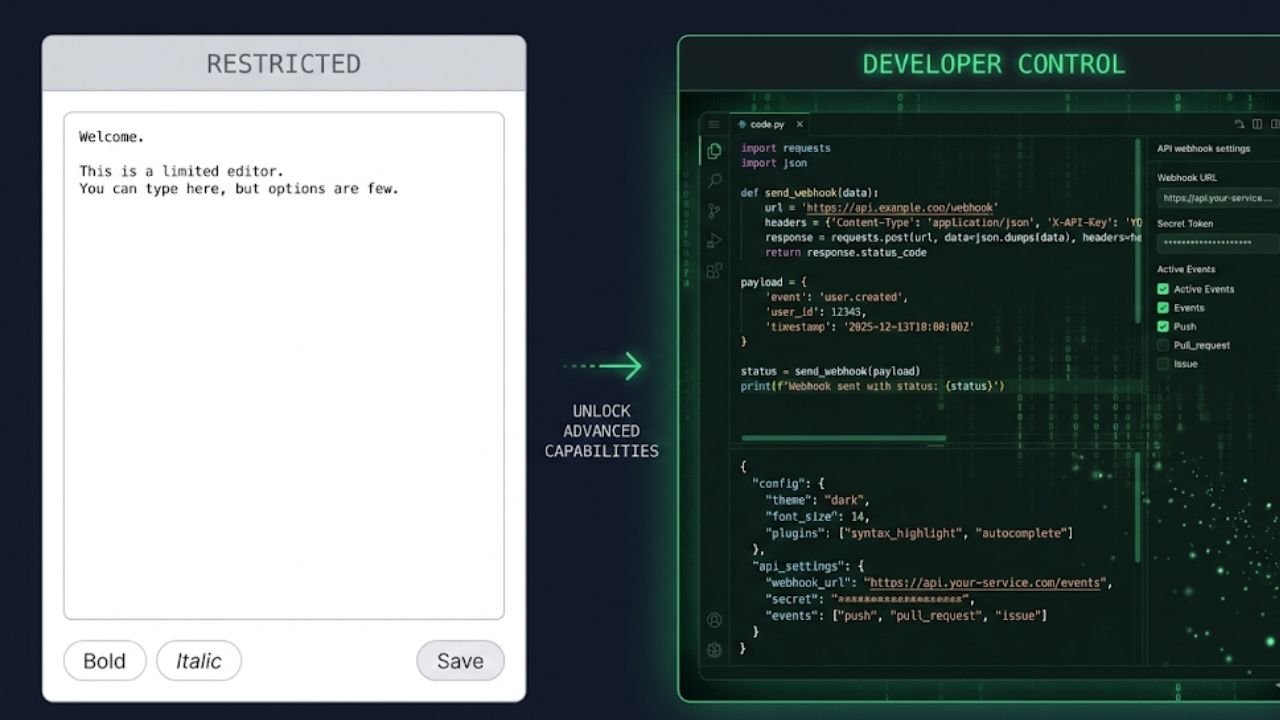
Ghost “speaks developer.” It is open-source software that you can self-host on a $5 DigitalOcean droplet if you prefer not to pay for Ghost(Pro).
Syntax Highlighting with Prism.js
Ghost supports Code Injection natively. You can drop a simple script into your site header to enable Prism.js, the gold standard for syntax highlighting.
- Implementation: You simply add the Prism CSS and JS links via CDN in the Ghost Admin panel.
- Result: Instantly, your code blocks support 200+ languages with perfect syntax highlighting, line numbers, and “Copy” buttons. Your
Pythontutorials look like they belong in an IDE, not a notepad.
Headless Node.js Architecture
Because Ghost is headless, you are not forced to use its front-end. You can use Ghost strictly as an API and build your front-end with Astro, Next.js, or Remix. This allows you to build a comprehensive portfolio site where the “Blog” is just one section powered by Ghost, while the rest is a custom React application demonstrating your skills.
Integrations & Webhooks
With Zapier and a robust JSON API, you can automate workflows to an granular degree.
- Example Workflow: “When a new user subscribes (Webhook), invite them to the private Discord server, add them to a GitHub repository, and generate a personalized license key for my software.”This level of automation is impossible on Substack, which remains a closed loop.
The Business Model (Membership vs. Newsletter)
The “Newsletter” is a limiting format. The “Membership” is a business.
Substack: The One-Trick Pony
Substack forces you into a specific model: Paid Newsletter. You write, they pay, you email.
- Rigidity: You cannot easily sell a “One-Time Course” or a “Digital E-book” without hacking together external links to Gumroad or Lemon Squeezy.
- Censorship Risk: In 2024 and 2025, Substack faced significant backlash for hosting extremist content (the “Nazi Bar” controversy) and subsequently engaging in opaque moderation. Because you are on their platform, you are subject to their Terms of Service and their brand reputation. If advertisers boycott Substack, your newsletter suffers collateral damage, regardless of your content.
Ghost: The Digital Commerce Engine
Ghost separates the “Content” from the “Access.” It is designed to sell digital products, not just emails.
- Tiers & One-Time Payments: As of 2025, Ghost introduced native “Tips & Donations” and supports multiple flexible tiers. You can have a “Free Tier” for general news, a “Pro Tier” for deep dives, and a “VIP Tier” that includes monthly consulting calls.
- Digital Products: Because you have full control over the theme (
.hbsfiles), you can gate specific pages. A tech blogger can create a library of downloadable React Components or PDF cheat sheets, gated behind a login. You are selling assets, not just text. - Ad-Hoc Monetization: Ghost does not penalize you for running your own sponsorships. If you sell a banner ad or a sponsored deep dive, you keep 100% of that revenue. Substack’s terms are murkier regarding ad networks and often discourage external monetization that bypasses their cut.
Migration and Implementation Strategy
If you have decided that ownership is worth the effort, the path from Substack to Ghost is well-trodden.
The Migration Path
Migrating is less painful than Substack would have you believe. Ghost offers a “Substack Migrator” tool.
- Export: In Substack settings, you export your posts (HTML) and your subscriber list (CSV).
- Import: In Ghost, you run the import tool. It maps your free subscribers to “Free Members” and your paid subscribers to “Paid Members” (via Stripe Connect).
- The Stripe Switch: Since Substack uses Stripe, you can often migrate the billing tokens directly, meaning your subscribers do not need to re-enter their credit card details. This preserves your recurring revenue stream during the switch.
Hosting Strategies
- Managed (Ghost Pro): Best for those who want to focus on writing. You pay the monthly fee, they handle updates, backups, and security.
- Self-Hosted (The Developer Way): For maximum savings, you can host Ghost on a VPS (Virtual Private Server) like DigitalOcean or Hetzner.
- Cost: ~$5-6/month for the server.
- Email: You will need to configure Mailgun for transactional emails. The “Flex” plan is very affordable for moderate volumes.
- Control: You have root access. You can install custom server-side analytics, firewalls, or run other apps on the same box.
The Decision Matrix
The choice between Ghost and Substack in 2026 is ultimately a choice between Convenience and Sovereignty.
| Feature | Substack | Ghost |
| Best For | Hobbyists, Political Commentary, Day 1 Beginners | Developers, Tech Strategists, Scaling Businesses |
| Fees | 10% of Revenue (Forever) | Flat Monthly Fee ($0 transaction fee) |
| SEO | Weak (Walled Garden) | Excellent (Schema, Speed, Control) |
| Customization | Colors & Fonts only | Full Code Injection, Theme API, Headless |
| Social Graph | Internal “Notes” (Locked in) | ActivityPub / Fediverse (Open Web) |
| Censorship | High Risk (Centralized Control) | Zero Risk (Self-Hostable) |
Key Takeaways
- The Winner for Economics: Ghost. Once you pass ~$300/month in revenue, Ghost becomes significantly cheaper. At $50k/year revenue, Ghost saves you over $4,000 annually.
- The Winner for Developers: Ghost. With Prism.js support, API access, and the ability to self-host on a VPS (Ubuntu/Docker), it fits the developer workflow perfectly.
- The Winner for Discovery: Tie (Nuanced). Substack offers better initial discovery for zero-audience writers via its internal network. Ghost offers better long-term organic discovery via SEO and Fediverse integration.
If you are writing code, you should be writing on code you control. Substack is a rented apartment where the landlord (the algorithm) can change the locks or hike the rent at any moment. Ghost is a plot of land you own. Building a house takes more work than renting a room, but in 2026, with AI threatening to commoditize generic content, owning your distribution channel is the only hedge that matters.
Still deciding? Check out other deep dives by Raven S on the AnimaVersa blog, where we dismantle tech trends without the corporate jargon.Don’t forget to follow and like AnimaVersa on Facebook, X, YouTube, Instagram, and TikTok for daily strategic insights.

Raven S., is a technologist, professional coder, and software enthusiast with a singular vision: to bring transparency, depth, and genuine expertise to tech journalism.