
# How to Build a 2026 AI Blogging Workflow, Stop churning out robotic trash. Discover the “Centaur” workflow used by top creators to blend Agentic AI research with human “Vibe Coding.” Master the 5-phase system today.

AnimaVersa – Let’s have a real, uncomfortable conversation about the state of the internet right now. It is loud. It is messy. And frankly, a lot of it feels completely dead inside. We are living through what I call the “Content Paradox.” We have tools that can generate 5,000 words in seconds—tools that are exponentially more powerful than what we had just two years ago—yet the “Helpful Content” updates from search engines are slaughtering websites that rely on that exact capability. The volume is up, but the connection is down.
If you are a creator in 2026, you feel this tension in your bones. You need to publish more to stay relevant in the algorithm, but if you publish garbage, you lose the human on the other side of the screen. We have all seen it: the “slop.” The endless stream of “In the ever-evolving landscape of digital marketing…” intros that make you want to throw your phone across the room. That is the sound of a writer who has given up. That is the sound of “prompt-and-pray,” the lazy method where you ask an LLM to “write a blog post about X” and paste the result. It creates flat, hallucinated, “uncanny valley” text that readers scroll past in milliseconds.
But here is the twist: the answer isn’t to reject AI. That is a luxury we don’t have. The answer is to become a Centaur.
I don’t mean the mythological beast. I mean the workflow philosophy where the human is the pilot and the AI is the engine. A Centaur writer doesn’t outsource their thinking; they outsource their grunt work. They use AI to amplify their unique “vibe,” not replace it. This isn’t about working harder. It’s about building a system.
In this massive guide, I am going to rip open my personal workflow. This is the 2026 AI Blogging Workflow. It moves through five distinct phases: Agentic Research, Skeleton Drafting, Vibe Coding, E-E-A-T Injection, and Autonomous Distribution. It utilizes tools like Perplexity, Claude Canvas, Oasis, and Gumloop to keep the soul intact while the AI handles the scale. Ready to stop sounding like a robot? Let’s build.
Read More: How to Start a Tech Blog in 2026: The Ultimate Beginner’s Guide
Agentic Research (The “Research Agent”)
The biggest mistake writers make is asking the AI to write before they have taught it anything. An LLM is a reasoning engine, not a knowledge base. If you ask it to write without data, it hallucinates. If you give it generic data, you get generic content. To win in 2026, we need Agentic Research. We need to simulate a team of interns digging for gold.
The Tool Stack
- Perplexity (Pro): The “Answer Engine.” We use this for real-time web retrieval.
- StackAI / Custom GPTs: For processing heavy documents (PDFs, whitepapers).
- Gemini 2.5 / Claude 3.5 Sonnet: For massive context window analysis.
The Problem with “Google Research”
In the old days, you would Google a keyword, open five tabs, skim them, and synthesize. That doesn’t work anymore because half of those tabs are AI-generated slop themselves. You are effectively training your brain on bad data. The 2025 State of Marketing reports highlighted that while 93% of marketers use AI to create content faster, consumers are increasingly skeptical of the authenticity of that content. We need to cut through the noise.
The Technique: Seeking the Contrarian
Don’t ask Perplexity: “What are the benefits of remote work?” Ask Perplexity: “Find recent studies from 2024-2026 that show the negative mental health impacts of remote work on Gen Z. Look for contrarian data points that oppose the popular narrative.”
This is the “Contrarian Data Point” strategy. Most AI content is “consensus content”—it aggregates the average opinion of the internet. To stand out, you need the outlier. You need the specific statistic that makes a reader stop and say, “Wait, really?”
The “Research Agent” Workflow:
- Source Aggregation: I use Perplexity to scan the latest industry reports. For example, if I’m writing about marketing trends, I’m not just looking for “AI is growing.” I’m looking for specific stats, like the fact that while AI marketing is projected to reach over $107 billion by 2028, a significant percentage of consumers still feel AI content lacks authenticity. I need that tension. I need the friction points.
- The “Persona Simulator”: I don’t just gather facts; I gather perspectives. I spin up a quick agent in StackAI or a custom Claude Project loaded with my target audience’s demographic data.
- The Interview: I literally interview the data. “Hey Claude, act as a burnt-out marketing manager. Read these three PDFs I just uploaded. What in here makes you angry? What feels like BS?”
You are gathering “Ingredients” that have texture. By finding contrarian data and simulating reader emotions before you write a single word, you ensure the content has a hook. You aren’t just summarizing the internet; you’re curating a fight.
Building a “Research Agent” in StackAI
If you are serious about scale, you don’t just chat with a bot; you build a workflow. StackAI allows you to create drag-and-drop workflows that can connect to the internet, scrape specific URLs, and process them through an LLM.
Imagine a workflow that triggers every Monday morning. It scrapes the top 5 news sites in your niche, extracts the headlines, and runs them through a “Contrarian Filter” that flags stories where the popular narrative might be wrong. That is what we mean by Agentic Research. It’s proactive, not reactive. It brings the insights to you.
The “Skeleton” Draft (The “Architect Agent”)
Now that we have the “ingredients” (our research notes, contrarian stats, and emotional angles), we do NOT ask the AI to “write the post.” We ask it to build the Skeleton.
The Tool Stack
- Claude (Canvas Mode) or OpenAI (Canvas Mode)
- Map of Content (Obsidian/Notion)
The “Vibe Check” Structure
In 2026, linear writing is dead. We write in modules. Readers scan. They look for headers, bold text, and visual breaks. If your structure is weak, your “vibe” won’t save you.
I open Claude Canvas (which I prefer for its “Artifacts” capability and superior coherence over long contexts). I paste my research notes from Phase 1.
The Prompt Strategy:
*”Act as an expert editor. Review these research notes. Create a detailed outline for a 2,000-word article titled ‘The Death of the Keyboard.’
Do not write the article. Only write the H2s, H3s, and bullet points for the key arguments in each section.
The structure must flow logically but feel unexpected. Start with a story, not a definition.”*
The “Architect” Intervention
Once Claude generates the skeleton in the Canvas window, I step in. This is crucial. I manually edit the outline. I move H2s around. I delete generic sections like “Conclusion” and replace them with specific headers like “The 80/20 Rule.”
I am the architect; the AI is the draftsman. I approve the blueprints before a single brick is laid. This prevents the “drifting” effect where AI starts rambling about irrelevant sub-topics halfway through the piece.
Tools like OpenAI’s Canvas and Claude’s Artifacts allow for “highlight-to-edit” functionality. This is a game-changer for the editing process. instead of asking the chat to “rewrite the third paragraph,” you highlight the paragraph and type “make this punchier.” It feels less like coding and more like sculpting.
We are seeing a shift in 2026 where the interface of AI is moving away from the “Chat” box and toward the “Document” view. The chat is ephemeral; the document is permanent. The “Centaur” writer lives in the document, using the chat only as a sidecar for commands.
The “Vibe Coding” Writing Process
This is the secret sauce. This is how you write 10x faster without sounding like a soulless machine.
Stop typing. Start talking.
Typing is a filter. It slows down your brain. When you type, you self-edit. You worry about grammar. Your “voice” gets flattened into “writing mode.” When you speak, you are naturally more rhythmic, punchy, and human.
The Tool Stack
- Oasis (or TalkTastic / Whisper): High-fidelity voice-to-text.
- Claude 3.5 Sonnet / GPT-4o: For style transfer.
The Technique: “Rant and Refine”
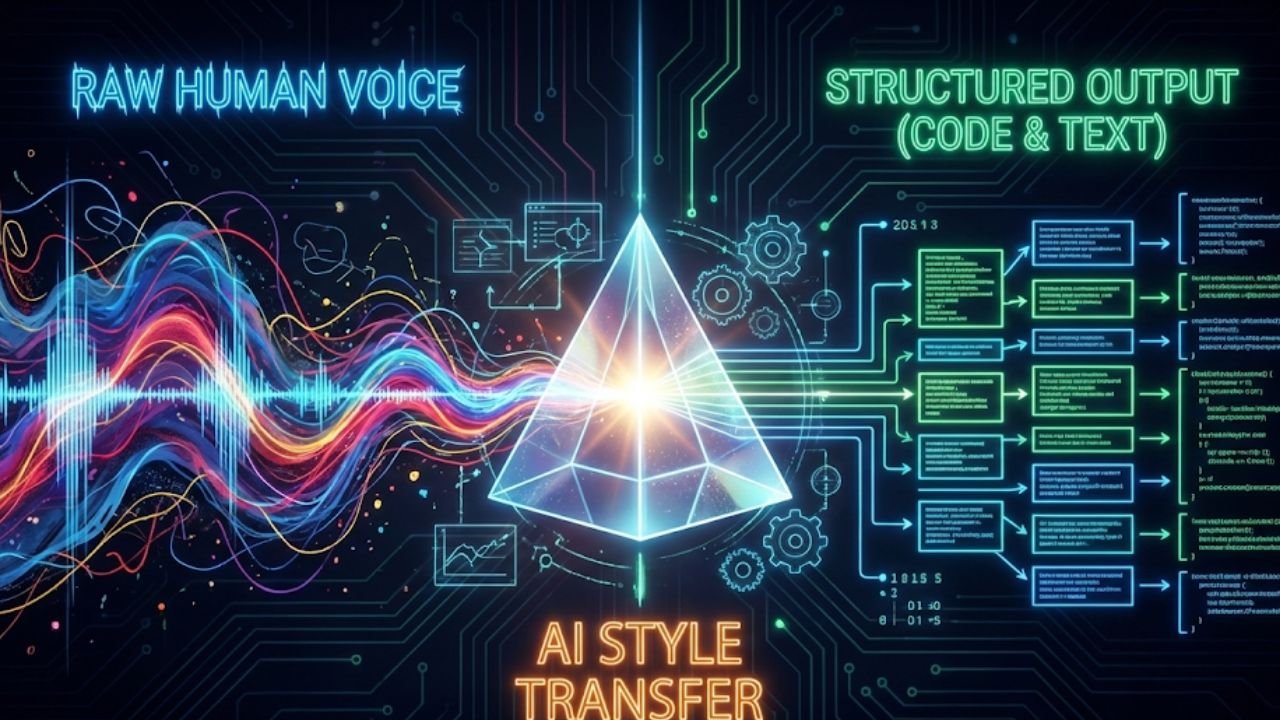
I call this Vibe Coding. It’s the process of capturing your raw biological “vibe” and coding it into text.
Step 1: The Rant I put on my headset, open Oasis, and I look at the “Skeleton” from Phase 2. Then, I just talk. I rant. I tell stories. I curse. I use analogies that barely make sense. I stumble. I say “um.”
“Okay, so for section 3, the main point is that people are lazy. It’s like… remember that time in 2024 when everyone used those bad auto-comment bots? It’s like that. We need to tell them to stop being lazy.”
I record for 10-15 minutes, covering the whole outline. This isn’t dictation; it’s a stream of consciousness. I am downloading my brain directly into the machine.
Step 2: The Transcribe Oasis (or your tool of choice) cleans up the “ums” but keeps the flow. Now I have a 3,000-word block of messy, raw, deeply human text. This text is ugly. It has run-on sentences. It has half-formed thoughts. But it has soul. It has my unique way of viewing the world. AI cannot hallucinate your specific worldview.
Step 3: The Style Transfer I take that raw transcript and paste it into Claude. This is where prompt engineering becomes art. I don’t just say “fix this.” I use a “Style Transfer” prompt.
The Prompt:
*”Here is a raw transcript of me ranting about this topic. I need you to clean this up into a polished blog post, BUT:
- Do NOT change my tone. Keep the energy, the slang, and the ‘vibe.’
- Do NOT sound like an AI. No ‘In the ever-evolving landscape.’
- Fix the grammar and structure, but keep the soul.
- Use the ‘Skeleton’ we agreed on earlier as the map.”*
The Result: You get a draft that sounds exactly like you, but polished. It has your cadence, your weird metaphors, and your opinions, but it’s structured perfectly. This is how you produce 5,000 words of “thought leadership” in 30 minutes. You aren’t generating text; you are generating thought, and the AI is just the stenographer.
Advanced “Vibe Coding” Tactics
If you really want to dial this in, you need to create a “Style Guide” for your AI. Upload three of your best human-written articles to Claude and ask it to analyze your voice. Ask it to define your “perplexities”—the length of your sentences, the frequency of your metaphors, the specific words you use.
Save this analysis as a “System Prompt.” Now, every time you feed it a rant, it knows exactly who it is writing as. You are effectively cloning your own writing persona. This is the ultimate “Centaur” move—using the machine to become a more consistent version of yourself.
(The “Fact-Checker”)
At this point, we have a great article. But Google doesn’t trust it yet. We need to inject E-E-A-T (Experience, Expertise, Authoritativeness, Trustworthiness).
AI cannot generate “Experience.” It has never lived. It has never failed a project. It has never lost money. You have.
The Action: Manual Surgery
I go through the “Vibe Coded” draft and perform manual surgery. I look for specific places to inject “Entity Signals.”
- First-Person Anecdotes: I find a generic sentence like “Marketing is hard” and replace it with “I remember in 2023 when I burned $10k on a Facebook ad campaign that got zero leads. That hurt.” AI cannot fake that specific pain.
- Original Visuals: I don’t use stock photos. I take screenshots of the actual workflows I’m describing. I grab a chart from my analytics. I paste them in.
- Semantic Linking: I ensure we are linking out to high-authority entities (like the HubSpot State of Marketing Report or World Economic Forum data) and linking internally to my topical clusters. This builds the “Knowledge Graph” that search engines crave.
The “Schema” Layer
This is the technical SEO nerd part. I ensure my author bio is tagged with Person schema, linking to my LinkedIn and Twitter. This tells the search engine: “This isn’t an anonymous AI blob. This is Raven S, a verified human expert.”
We are moving toward Entity SEO. Search engines are no longer just matching keywords; they are mapping entities. They want to know that “Raven S” is an entity that knows about “Content Strategy.” By consistently linking your content to your specific entity profile (your social media, your other articles, your Crunchbase profile), you build a “Knowledge Graph” that makes your content unshakeable.
Google’s “Helpful Content” updates have made it clear: they want “Hidden Gems.” They want the stuff that isn’t on the rest of the internet. That usually means personal experience. If your article could have been written by anyone, it will rank for nothing. The “Vibe Coding” process helps here, but you need to consciously review your draft and ask: “Is there anything in here that only I could know?” If the answer is no, you need to rewrite.
Autonomous Distribution
You have written a masterpiece. Now, if you just hit “publish” and walk away, you have failed. In 2026, distribution is 50% of the work. But this is where we can let the robots take over again. We use Agentic Automation to turn one post into a multimedia omni-channel blast.
The Tool Stack
- Gumloop: The node-based AI automation platform (think Zapier on steroids).
- Ghost: The CMS that talks to the Fediverse.
- Typefully / Taplio: For social scheduling.
The Workflow: The “Content Waterfall”
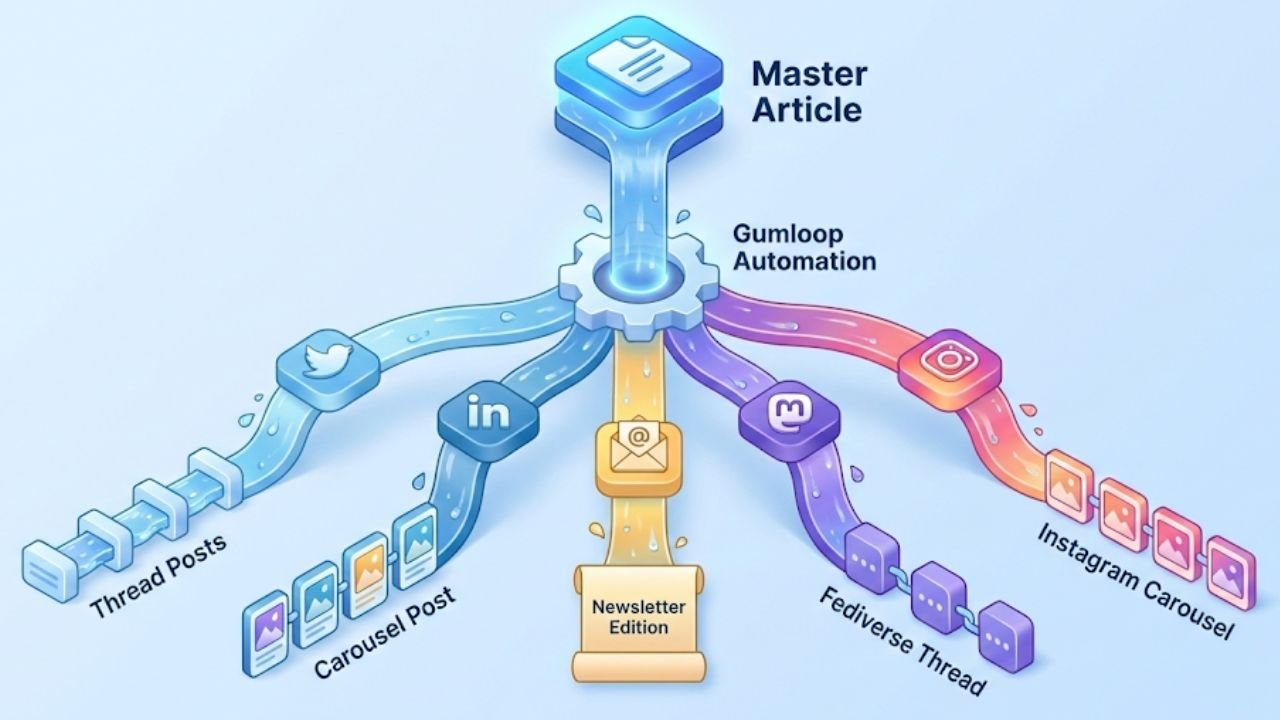
I have a Gumloop flow set up that triggers the moment I mark a post as “Published” in my Ghost CMS. Gumloop is fantastic because it allows you to drag and drop “nodes” that perform AI tasks. It’s visual coding for non-coders.
The Gumloop Diagram:
- Trigger: New RSS Item from Blog.
- Node A (The Threader): The content is sent to an LLM node with instructions: “Turn this 2,000-word post into a viral 12-tweet thread. Focus on the contrarian hooks. Use short sentences. Don’t use hashtags.”
- Node B (The Professional): The content is sent to a different LLM node: “Summarize this for a LinkedIn carousel. Professional tone, focus on business ROI. Create 5 slides worth of text.”
- Node C (The Newsletter): The content is reformatted into a “TL;DR” email for my subscribers who don’t have time to click.
- Node D (The Fediverse): Because I use Ghost, my blog is my Fediverse profile. When I hit publish, it automatically federates out to Mastodon, Threads, and the rest of the ActivityPub network. I don’t need to manually post there. It just happens.
Visualizing the Flow: Imagine a waterfall. You pour water (the blog post) at the top, and gravity (Gumloop) splits it into five different streams (Twitter, LinkedIn, Newsletter, Fediverse, Slack). You did the work once; the system did the distribution five times.
Why the Fediverse Matters in 2026
We are seeing the collapse of the “Walled Gardens.” Twitter (X), LinkedIn, and Instagram are trying to keep you trapped. But the Fediverse (powered by ActivityPub) is opening the doors. By using a platform like Ghost, you own your connection to your audience. When you publish, it goes directly to their feeds, uncensored and un-throttled.
This is the ultimate “Centaur” distribution play: owning the protocol, not just the platform. It means your “Vibe Coded” content isn’t at the mercy of an algorithm change next Tuesday. It lives on your server, broadcast to the world.
Here is the reality of the 2026 workflow:
- 80% of the time is spent on Research (Phase 1) and Vibe Coding (Phase 3). This is the human work. This is the soul.
- 20% of the time is spent on Drafting (Phase 2) and Distribution (Phase 5). This is the robot work.
The Centaur model flips the script. We used to spend hours typing and minutes thinking. Now, we spend hours thinking (and ranting) and minutes typing. The goal isn’t to let AI say it for you. It’s to let AI help you say it louder.
We are entering an era where “Human-Created” is a premium label. But “Human-Created” doesn’t mean “Manual-Only.” It means “Human-Directed.” It means you are the conductor of a symphony of agents. You tell the research agent where to dig. You tell the architect agent how to frame the house. You tell the distribution agent where to send the invites. But you provide the music. Stop being a writer. Start being a Centaur.
Key Takeaways
- Agentic Research: Use tools like Perplexity to find “contrarian data” rather than generic facts.
- Skeleton Drafting: Never write from scratch. Use Canvas to architect the structure before generating text.
- Vibe Coding: Voice-to-text is the killer app for retaining “soul.” Rant, transcribe, and use style transfer.
- E-E-A-T Injection: Manually insert pain, failure, and specific anecdotes. AI cannot hallucinate experience.
- Autonomous Distribution: Use Gumloop to turn one asset into a dozen social native pieces automatically.
Check out other articles by Raven S for more “Vibe Coding” tutorials. Don’t forget to follow and like AnimaVersa on Facebook, X, YouTube, Instagram, and TikTok for daily workflow hacks. Now that you have the workflow, you need the platform to support it. Learn how to set up your Fediverse-Ready Blog to broadcast your new content across the decentralized web.

Raven S., is a technologist, professional coder, and software enthusiast with a singular vision: to bring transparency, depth, and genuine expertise to tech journalism.